English can be tricky, especially when words that seem to mean the same thing aren’t always used in the same way. If you’ve ever wondered whether to say “recurring” or “reoccurring,” you’re not alone. These two words are often confused, even by native speakers.
In this article, we’ll clear up the confusion and explain when and why you should use each one. By the end, you’ll know which is correct for your writing and why.
Recurring vs Reoccurring – Quick Answer
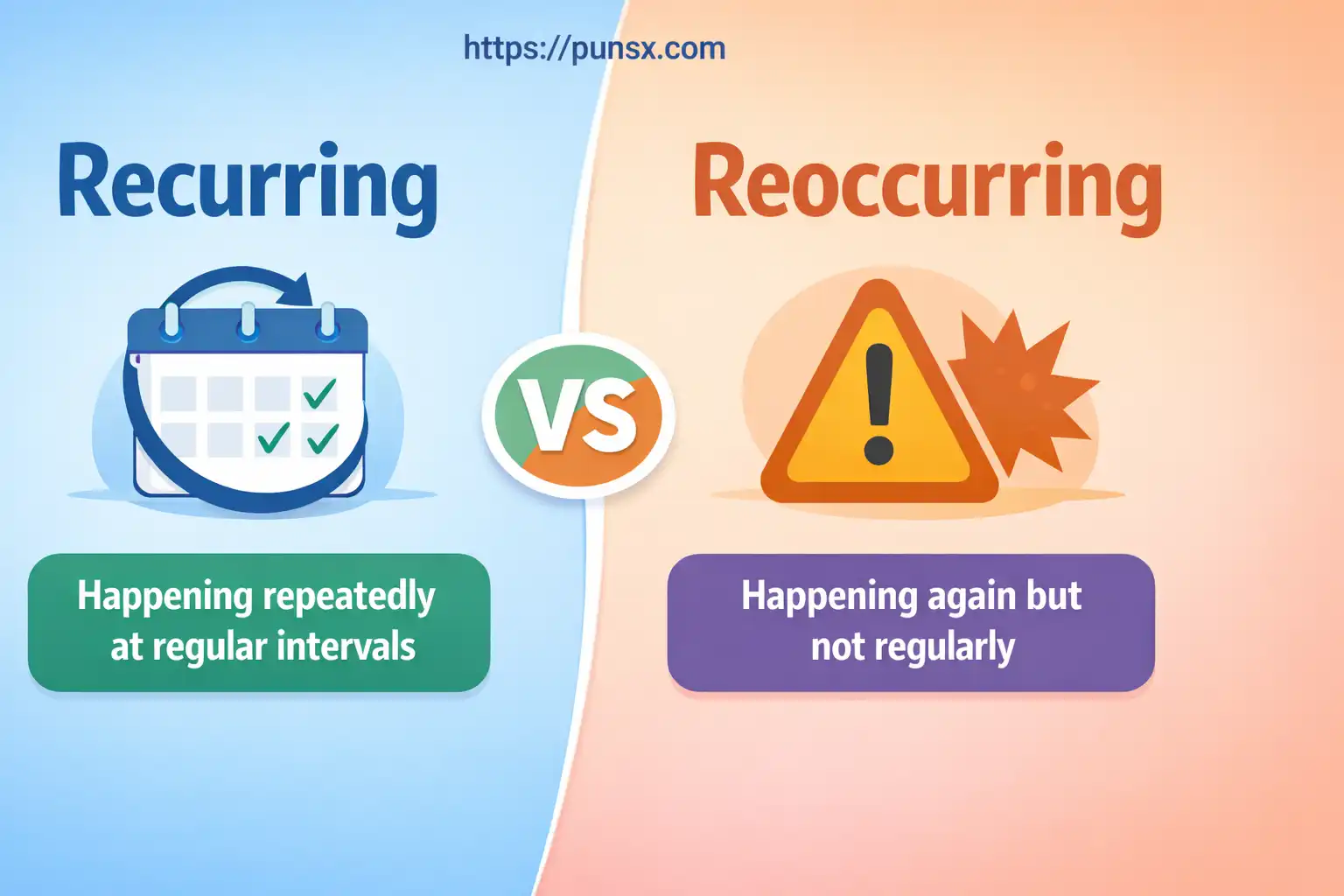
- Recurring refers to something happening repeatedly over time.
- Reoccurring is often incorrectly used in place of “recurring,” but it’s less common in formal English.
Rule: Always use “recurring” in most contexts. “Reoccurring” is a rare variation and should be avoided unless absolutely necessary.
The Origin of Recurring and Reoccurring
Both “recurring” and “reoccurring” come from Latin roots, but their paths diverged as the words evolved in English. “Recurring” comes from the verb recur, which means to happen again, while “reoccurring” combines the prefix “re-” with “occurring.” Despite this, the use of “reoccurring” has become less favored in modern English.
The use of “recurring” is more widely accepted, both in formal and informal writing. Editors and writers prefer “recurring” because it sounds more natural and has become standardized over time.
Reason for Confusion Today
Writers often confuse “recurring” and “reoccurring” because they both seem to refer to events that repeat. However, the confusion arises because “reoccurring” is not technically wrong—it’s just unnecessary. Many people mistakenly use it thinking it sounds more formal or specific, but this simply isn’t the case.
The preference for “recurring” is strong, especially in professional, academic, and journalistic contexts. So, while “reoccurring” might still appear in some texts, it’s considered a misstep in most cases.
British English vs American English Spelling
There is no major difference between British and American English when it comes to “recurring” and “reoccurring.” Both forms are used in the same way, and both prefer “recurring” in almost all contexts.
| Spelling | Usage |
| Recurring | Standard in both British and American English |
| Reoccurring | Rare, typically used incorrectly |
For clarity, “recurring” should be your go-to choice, no matter where you are located.
Which Spelling Should You Use?
The correct word to use, regardless of your location, is recurring.
- For US and UK audiences: Stick with “recurring”.
- For formal and professional writing: Avoid using “reoccurring” entirely.
- For casual contexts: You may see people use “reoccurring,” but it’s best to opt for “recurring” to keep your writing clear and accurate.
Common Mistakes with Recurring
Many writers mistakenly use “reoccurring” when “recurring” is the proper choice. Here’s a breakdown of the mistakes:
❌ Incorrect: The event keeps reoccurring every few months.
✅ Correct: The event keeps recurring every few months.
❌ Incorrect: She has reoccurring dreams about flying.
✅ Correct: She has recurring dreams about flying.
This small change can make a big difference in how your writing is received by your audience.
Recurring in Everyday Examples
Let’s look at how to use “recurring” in different scenarios:
- Emails: “I’ve noticed a recurring issue with the system crashing.”
- News: “The recurring theme in this story is hope despite hardship.”
- Social Media: “This recurring joke is hilarious every time I hear it.”
- Formal Writing: “The recurring nature of the storm has been a cause for concern.”
In each case, “recurring” fits naturally and communicates that something happens over and over.
Recurring – Usage Patterns & Search Interest
The word “recurring” is far more popular than “reoccurring.” It’s a key term that appears in many fields, from medical terminology (recurring symptoms) to finance (recurring payments). The majority of searchers are likely students, ESL learners, and writers who want clarity on when and how to use these words properly. Misusing “reoccurring” instead of “recurring” could lead to awkward or unclear writing.
Comparison Table: Recurring vs Reoccurring
| Aspect | Recurring | Reoccurring |
| Meaning | Happening repeatedly over time | A rare variant of recurring |
| Part of Speech | Adjective | Adjective |
| Context of Use | Common in formal and informal use | Less common, mostly avoided |
| Formal Usage | Preferred in professional writing | Not recommended in formal writing |
| Common Mistakes | Confused with “reoccurring” | Often used incorrectly in place of “recurring” |
| Correct Example | “She has recurring headaches.” | “She has reoccurring headaches.” (incorrect) |
SEMANTIC FAQs (People Also Ask)
- Is recurring the same as reoccurring?
No, “recurring” is the preferred term. “Reoccurring” is rarely used and often incorrect. - Which one is correct in formal writing?
Use “recurring” in formal writing. “Reoccurring” is not considered correct. - Can they be used interchangeably?
It’s best to avoid “reoccurring” and stick to “recurring” for clarity and correctness. - Why do people confuse them?
Both words seem to have the same meaning, but “reoccurring” is unnecessary and not commonly accepted in modern English. - Can grammar tools catch this mistake?
Yes, grammar tools like Grammarly often flag “reoccurring” as incorrect, recommending “recurring” instead. - Is there a British vs American difference?
No, both British and American English use “recurring” as the correct form.
Conclusion
In short, when choosing between “recurring” and “reoccurring,” always opt for “recurring.” It is the standard, widely accepted term in both British and American English.
Avoid using “reoccurring” in formal writing or professional contexts. If you remember one rule, it’s this: “Recurring” is the safe and correct choice. Stick to it for clear, effective communication.

I’m James Baldwin, author at PunsX.com, and I’m an expert in crafting clever, shareable puns.
I turn simple ideas into fun wordplay that makes people smile.