You see it everywhere. In emails,homework and posts online. Someone writes payed, and another person says it should be paid. This small spelling choice causes big confusion. Many learners stop and wonder which one is right. Some even change a correct word into a wrong one.
This confusion happens because both words look real. They both come from the verb pay. Spellcheck tools do not always help. So mistakes keep spreading, especially in fast writing like chats or social posts.
This article fixes that problem. You will learn the clear difference between payed and paid also see when each word is used and why one is almost always wrong. You will also get simple rules, real examples, and one easy trick to remember the right choice. By the end, this topic will feel calm and clear.
Payed or Paid – Quick Answer
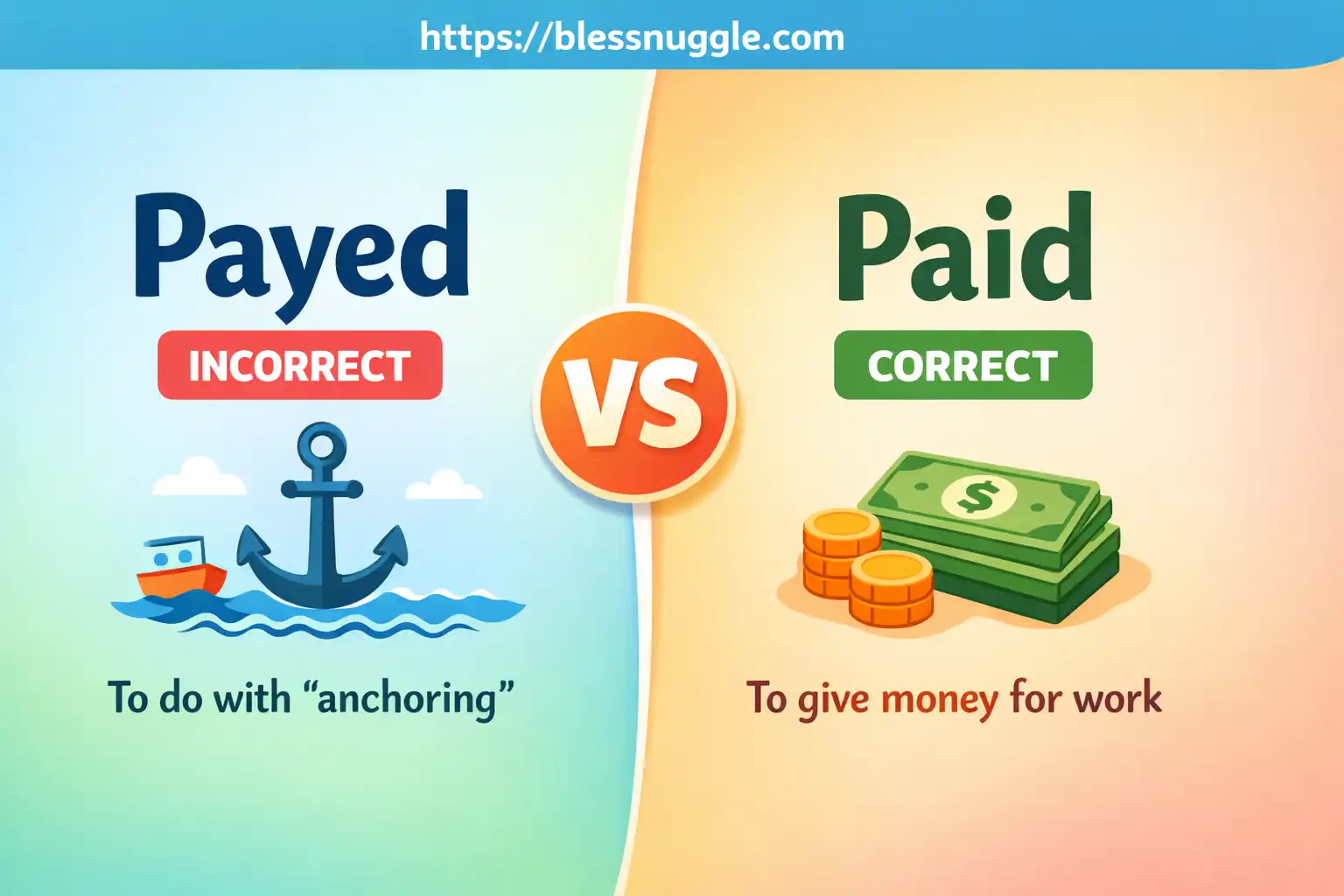
Paid is the correct past tense of pay in almost all cases.
Payed is rare and used only for ships and ropes.
- I paid the bill yesterday. ✅
- The sailor payed the rope on the deck. ⚓
Easy rule: If money is involved, always use paid.
The Origin of Payed or Paid
The verb pay comes from old words about giving value. Over time, English changed its past tense form. Instead of payed, the language settled on paid. This change happened long ago, and writers followed it.
However, payed did not disappear fully. It stayed in a very small corner of language. Sailors and ship workers still use payed when talking about ropes, chains, or decks. This meaning is physical, not about money.
Today, most people never see that use. So when they see payed, it looks wrong. Writers often guess and add “-ed,” because many verbs work that way. That guess causes the common mistake.
British English vs American English Spelling
Here is the good news. There is no spelling difference between British and American English for this case.
Both forms follow the same rule:
- Paid → money, salary, bills, fines
- Payed → nautical use only
In contrast to words like color and colour, this pair stays the same everywhere.
| Context | Correct Form |
| US writing | paid |
| UK writing | paid |
| Global English | paid |
So now, location does not change the answer. Meaning does.
Which Spelling Should You Use?
The choice depends on context, not audience.
- US readers: Use paid for all money-related writing.
- UK / Commonwealth readers: Also use paid.
- Global or professional writing: Always use paid, unless writing about ships.
If you are not writing about ropes on a ship, you should not use payed. In modern writing, paid covers nearly every real situation.
Common Mistakes with Payed or Paid
Writers often make the same errors. Here are the most common ones.
- ❌ I payed my rent today.
✅ I paid my rent today. - ❌ She payed for the tickets online.
✅ She paid for the tickets online. - ❌ The company has not payed us yet.
✅ The company has not paid us yet.
These mistakes matter because they stand out. Editors usually notice them fast. Readers may question your writing skills because of one small word.
Payed or Paid in Everyday Examples
Let’s see how paid works in real life.
Emails
- I have paid the invoice. Please confirm.
News
- The worker was paid fairly after the case ended.
Social media
- Finally paid off my student loan today!
Formal or professional writing
- All fees must be paid before the deadline.
Now the rare one:
Nautical use
- The crew payed the rope along the rail.
That last example is correct, but very uncommon.
Payed or Paid – Usage Patterns & Search Interest
People search this topic because they feel unsure. Students see different spellings online. ESL learners hear one word but see another. Writers pause because both forms look possible.
Editors usually see payed used by mistake. Grammar tools sometimes miss it, so the error slips through. In school or work, that can hurt clarity and trust.
A common real-world problem happens in emails about money. If you write “payed,” the reader may focus on the error instead of your message. That small distraction can matter.
Comparison Table: Payed vs Paid
| Feature | Paid | Payed |
| Meaning | Gave money | Let out rope |
| Part of speech | Past tense verb | Past tense verb |
| Context of use | Money, salary, bills | Ships, ropes |
| Formal or informal | Both | Technical only |
| Common mistake | Rare | Often misused |
| Correct example | I paid the bill | He payed the line |
Semantic FAQs (People Also Ask)
Is payed the same as paid?
No. Paid is for money. Payed is for ropes on ships.
Which one is correct in formal writing?
Paid is correct in almost all formal writing.
Can they be used interchangeably?
No. They have different meanings and uses.
Why do people confuse them?
Because most verbs add “-ed,” and payed looks logical.
Can grammar tools catch this mistake?
Sometimes, but not always.
Is there a British vs American difference?
No. Both use paid the same way.
Conclusion
Overall, this topic is simpler than it looks. The confusion comes from spelling habits, not meaning. English usually forms past tense with “-ed,” so payed feels right at first. But language history chose a different path here.
In short, paid is the word you need for money, work, fees, and bills. It works in emails, school writing, news, and professional documents. Payed belongs to ships, ropes, and sea talk. Most writers will never need it.
The one mistake to always avoid is using payed when money is involved. That error stands out and can distract your reader.
Finally, remember this easy rule: If you can replace the word with “money,” use paid. That rule works every time.