Have you ever stumbled upon the words “neither” and “either” and wondered if they are the same? Many students and English learners face this confusion when trying to decide which word to use in different sentences. This article will clarify the difference between “neither” and “either” to help you choose the right word in the right context.
Whether you’re writing an email, a report, or just chatting with friends, knowing how to use these words correctly can make your writing sound more polished. By the end of this guide, you’ll understand the differences, how to avoid common mistakes, and know exactly when to use each word. Let’s dive into this simple yet often confusing topic.
Neither – Quick Answer
- Neither is used when referring to two things, where not one or the other is true or applicable.
- It’s commonly used in negative constructions.
Examples:
- “Neither option works for me.”
- “I want neither coffee nor tea.”
The Origin of Neither and Either
“Neither” and “either” both have roots in Old English, but they have evolved over time to carry distinct meanings.
- Either comes from the Old English ǣgther, meaning “one of two.”
- Neither comes from the Old English nāther, meaning “not one of the two.”
These origins still shape their use today, with “either” often used when speaking about a choice between two items, and “neither” used when excluding both options.
Reason for Confusion Today
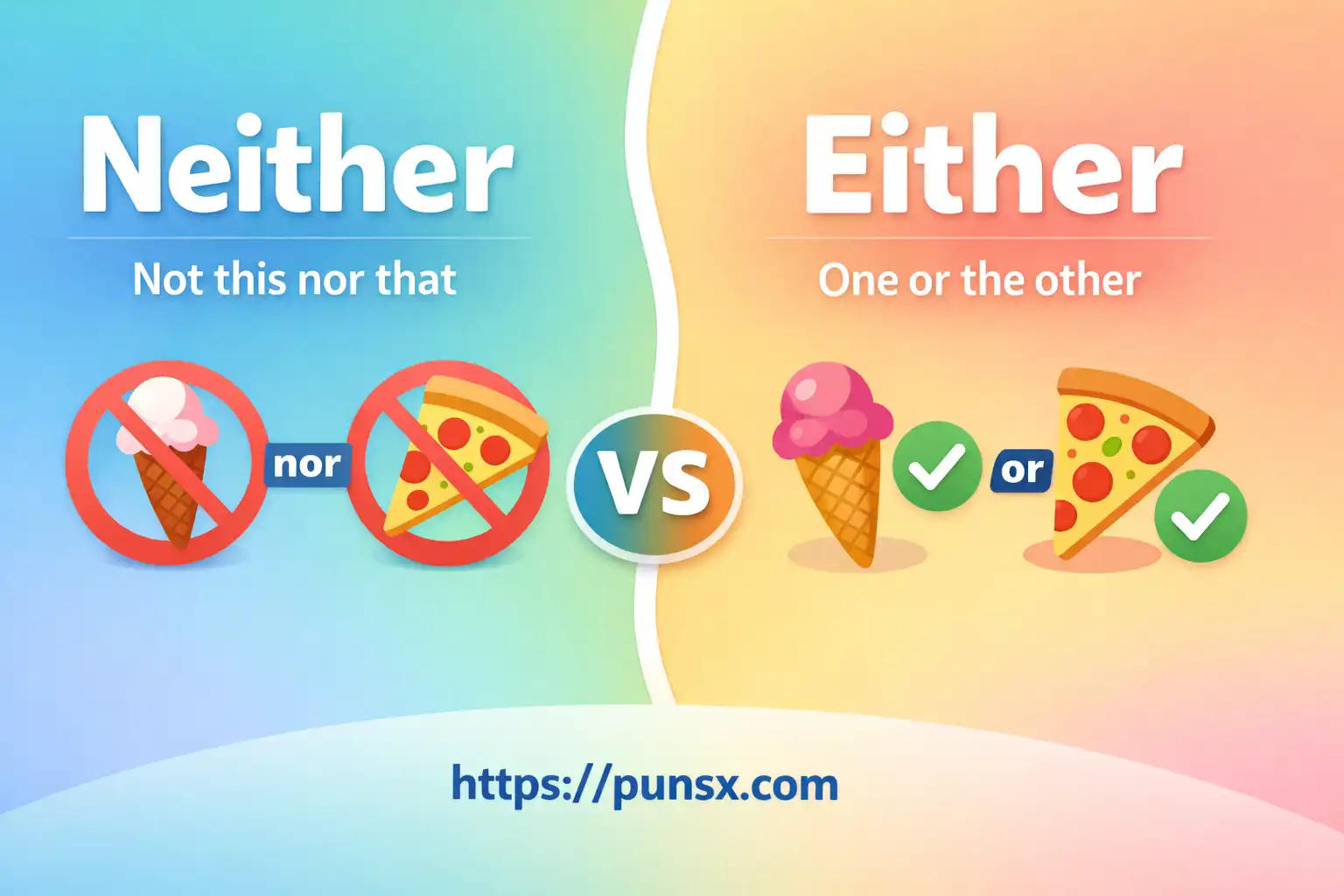
The confusion between “neither” and “either” mainly arises because both words deal with choices or options between two things. However, the key difference is their meaning:
- Either refers to one of two options.
- Neither refers to not one of two options.
This subtle difference often trips up learners who may mix them up in everyday conversation or writing.
British English vs American English Spelling
Spelling Differences:
- There is no significant spelling difference between “neither” and “either” in British and American English.
Example:
- In both American and British English, we write “either” and “neither” the same way.
Which Spelling Should You Use?
Since there are no major spelling differences, the choice of spelling depends more on your audience:
- Use “either” and “neither” in both British and American English unless you’re specifically tailoring for one of those regions.
For global or professional writing, it’s essential to stick with the standard spellings of “either” and “neither.”
Common Mistakes with Neither and Either
Writers, especially beginners and ESL learners, often confuse these words. Let’s see some frequent errors and how to fix them:
❌ Incorrect: Either option doesn’t work for me.
✅ Correct: Neither option works for me.
❌ Incorrect: I’ll go with neither of the two choices.
✅ Correct: I’ll go with either of the two choices.
These mistakes happen because “either” implies one option, while “neither” implies no option at all.
Neither and Either in Everyday Examples
Emails:
- Either: “Either Monday or Tuesday works for the meeting.”
- Neither: “Neither Monday nor Tuesday works for the meeting.”
News:
- Either: “Either the company will raise funds, or they will close.”
- Neither: “Neither raising funds nor closing are options for the company.”
Social Media:
- Either: “You can either go to the party or stay home.”
- Neither: “I’m inviting neither of you to the party.”
Formal or Professional Writing:
- Either: “Either candidate would make a good choice.”
- Neither: “Neither candidate meets all the job qualifications.”
Neither and Either – Usage Patterns & Search Interest
The confusion between “either” and “neither” is common among students, English learners, and writers. It’s often searched by people trying to get better at using English for daily conversations, business emails, or academic papers.
One real-world example of confusion is in decision-making. A writer might say, “Either answer will do,” when they actually mean, “Neither answer is acceptable.” This can lead to misunderstandings.
Comparison Table
| Meaning | Part of Speech | Context of Use | Formal vs Informal | Common Mistakes | Correct Example |
| Either: One of two options. | Pronoun/Conjunction | Positive choice | Both formal and informal | ❌ “Neither option works” | ✅ “Either option works.” |
| Neither: Not one of two options. | Pronoun/Conjunction | Negative choice | Both formal and informal | ❌ “Either option doesn’t work” | ✅ “Neither option works.” |
SEMANTIC FAQs
1. Is either the same as neither?
No, either means one of two options, while neither means not one of the options.
2. Which one is correct in formal writing?
Both either and neither are correct in formal writing, as long as they are used in the right context.
3. Can they be used interchangeably?
No, either refers to one of two options, and neither refers to none.
4. Why do people confuse them?
People confuse them because both deal with choices between two options, but they have opposite meanings.
5. Can grammar tools catch this mistake?
Yes, grammar tools like Grammarly can catch these mistakes, but it’s better to understand the difference yourself.
6. Is there a British vs American difference?
No, there is no difference between either and neither in British and American English. The spelling is the same.
Conclusion
In short, either and neither are both important words to master in English, but they are used in different situations. Either is for a choice between two things, while neither means no choice between the two. Avoid mixing them up by remembering this simple rule:
- Use either when one of two options is valid.
- Use neither when none of the options are valid.
With this in mind, you’ll avoid common mistakes and sound more confident in your writing and speaking.

I’m James Baldwin, author at PunsX.com, and I’m an expert in crafting clever, shareable puns.
I turn simple ideas into fun wordplay that makes people smile.