When writing, you may have come across the terms “acknowledgement” and “acknowledgment.” Both of these words seem similar, but they cause confusion for many writers and learners alike.
So, which one is correct to use, and when? Is there a difference, or can they be used interchangeably? Let’s clear up this confusion and understand the origins, rules, and real-world applications of these terms.
Acknowledgement – Quick Answer
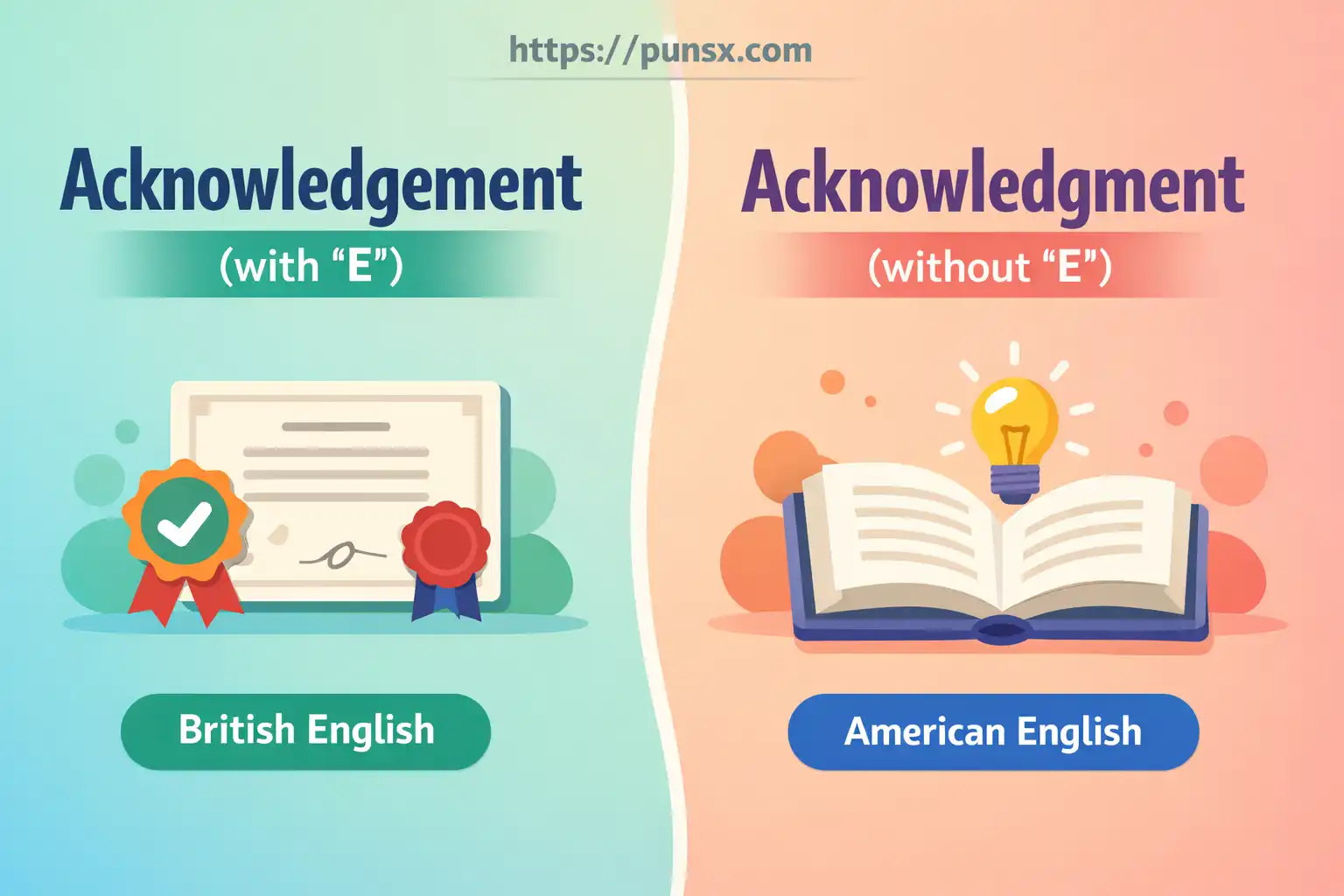
- Acknowledgement (with “e”) is the British English spelling.
- Acknowledgment (without “e”) is the American English spelling.
- Both words mean the same thing but are used in different regions.
Examples:
- British: The company’s acknowledgement of the issue well-received.
- American: The company’s acknowledgment of the issue well-received.
The Origin of Acknowledgement
Both “acknowledgement” and “acknowledgment” come from the verb acknowledge, which itself stems from Middle English acnawen, meaning to recognize or admit. The word evolved over time in both American and British English, but the spelling difference has remained consistent.
- British English prefers “acknowledgement,” maintaining the “e” after the “g.”
- American English dropped the “e,” making “acknowledgment” the standard.
The reason for this spelling divergence likely traces back to language simplification trends in the United States, influenced by Noah Webster’s reform in the 19th century.
Reason for Confusion Today
The confusion arises because both spellings are still widely used, depending on the region. Writers often wonder if they’re making a mistake by using one form over the other, especially in global contexts. Furthermore, both versions correct in their respective regions, but learners and writers must be aware of which version preferred where.
British English vs. American English Spelling
Here’s a quick look at the spelling differences:
| Spelling | Region | Example Sentence |
| Acknowledgement | British English | I received an acknowledgement of the payment. |
| Acknowledgment | American English | I received an acknowledgment of the payment. |
Which Spelling Should You Use?
- For American audiences: Always use “acknowledgment” (no “e”).
- For British audiences: Use “acknowledgement” (with “e”).
- Global or professional writing: If you’re writing for an international audience, it’s often best to choose one version and stick with it for consistency. Alternatively, you may follow the regional standards of the audience you’re addressing.
Common Mistakes with Acknowledgement
One common mistake writers make is using the wrong version based on their audience. For example:
- Incorrect: The letter of acknowledgement sent.
- Correct: The letter of acknowledgment sent. (for American English)
To avoid confusion, always double-check which spelling is preferred for your target audience.
Acknowledgement in Everyday Examples
Let’s see how this word shows up in different contexts:
- Emails: “Thank you for your acknowledgement of my request.”
- News: “The company issued an acknowledgment of the delay.”
- Social Media: “We appreciate your acknowledgement of our post.”
- Professional Writing: “Please send your acknowledgement of this letter by Friday.”
In each case, the word functions similarly. Whether you’re confirming receipt, recognizing something, or admitting an issue, the message remains clear, regardless of the spelling.
Acknowledgement – Usage Patterns & Search Interest
The search interest in “acknowledgement” vs. “acknowledgment” typically follows a pattern based on location. People in the United States search for “acknowledgment” more often, while those in the UK search for “acknowledgement.”
Typical user groups:
- Students and ESL learners often seek clarification about these terms.
- Writers, editors, and business professionals who need to adhere to regional standards.
Real-world confusion: Imagine a writer in the UK submits a document with the American version of the word, “acknowledgment,” to a British editor. The editor might see this as an inconsistency in style or assume that the writer is unfamiliar with British English norms.
Comparison Table: Acknowledgement vs Acknowledgment
| Aspect | Acknowledgement | Acknowledgment |
| Meaning | The act of recognizing or admitting something | The act of recognizing or admitting something |
| Part of Speech | Noun | Noun |
| Context of Use | Used in British English | Used in American English |
| Formal Usage | Common in professional, academic contexts | Common in professional, academic contexts |
| Informal Usage | More common in casual British writing | More common in casual American writing |
| Common Mistakes | Using “acknowledgment” in British English | Using “acknowledgement” in American English |
| Correct Example | “The acknowledgement of the error was appreciated.” | “The acknowledgment of the error was appreciated.” |
Semantic FAQs
- Is “acknowledgement” the same as “acknowledgment”?
Yes, both mean the same thing but differ in spelling based on British or American English preferences. - Which one is correct in formal writing?
Both are correct; choose the spelling based on your audience’s location (British or American). - Can they be used interchangeably?
Yes, but use the appropriate version for the region or audience you’re addressing. - Why do people confuse them?
The confusion arises because the words are used in the same contexts, but the spelling changes based on region. - Can grammar tools catch this mistake?
Some tools can flag this as a spelling mistake, especially if they’re set to a specific region (British or American). - Is there a British vs American difference?
Yes, “acknowledgement” is used in British English, and “acknowledgment” is used in American English.
Conclusion
To sum up, the main takeaway here is simple: the difference between acknowledgement and acknowledgment lies in regional spelling. For British audiences, use “acknowledgement,” and for American audiences, use “acknowledgment.” This distinction helps maintain clarity in professional, academic, and casual writing. So, always ensure you’re using the correct version based on your audience, and you’ll avoid unnecessary mistakes.
Remember, it’s a small difference, but it’s one that can make your writing feel more polished and regionally appropriate.

I’m Donna Ashworth, author at PunsX.com, and I’m an expert in writing clever, fun puns.
I turn everyday ideas into light, shareable humor people enjoy.