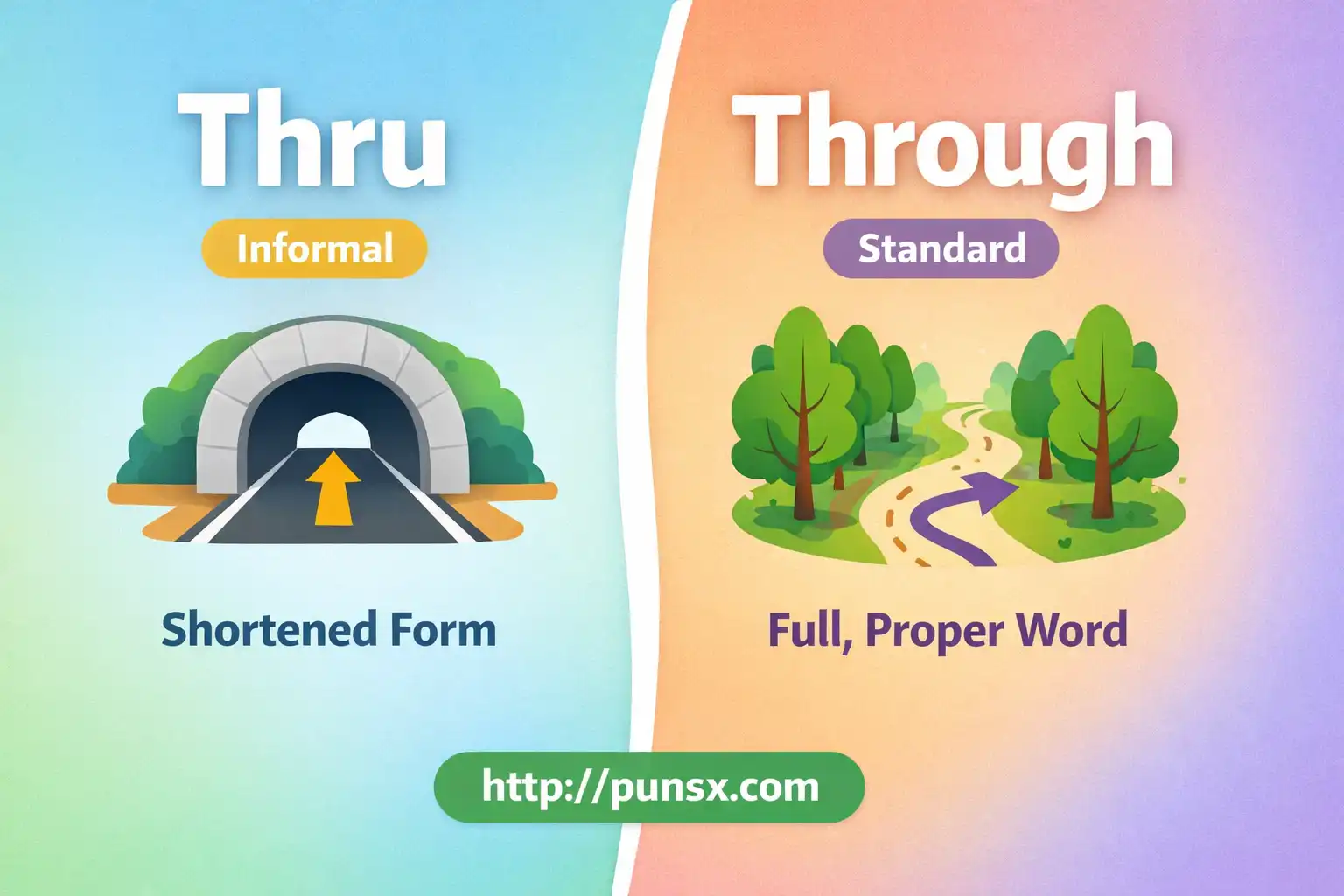
Many English learners and writers often get confused between “thru” and “through.” Both words may seem similar, but they have different usages and contexts that can easily lead to mistakes. In this article, we will break down when and why you should use each word. We’ll also explore the common errors people make, how to spot them, and the one rule you should always remember to avoid confusion.
Let’s dive into this confusion and learn how to use these words correctly in both casual and formal writing.
Thru vs Through – Quick Answer
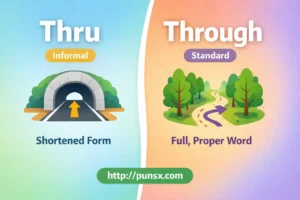
- Through is the correct form to use in formal and professional writing.
- Thru is an informal, shortened version often used in signs, advertising, or casual speech.
- Through is used in sentences referring to a complete journey, process, or time.
- Thru is typically seen in shorthand forms like road signs or quick notes.
Examples:
- “We walked through the door.” (Correct for formal writing)
- “Drive thru for fast food.” (Commonly used in casual language)
The Origin of Thru or Through
Both “thru” and “through” come from Old English, where “through” was the standard form. The word “through” has been used for centuries in English literature, signifying completion, movement, or passage. It traces its roots back to Proto-Germanic and Proto-Indo-European languages.
The use of “thru” as an abbreviation emerged as a more recent development, primarily for convenience in informal communication, like road signs or advertising. Over time, its use expanded in the United States, particularly in fast food chains and colloquial contexts, but “through” remains the formal, standard version.
Reason for Confusion Today
The confusion between “thru” and “through” mainly arises because of how informal language has evolved in modern communication. “Thru” is commonly used in casual contexts, while “through” holds its ground in academic, formal, and professional settings. For instance, “drive-thru” in a fast-food restaurant is a common expression, but in formal writing or essays, “drive-through” is preferred.
Since “thru” is often used in street signs, advertisements, and quick messages, it creates a pattern of using “thru” instead of “through.” However, this can lead to confusion when people are unsure which word is appropriate for formal writing.
British English vs American English Spelling
Interestingly, “thru” is mostly used in American English, particularly for commercial purposes. British English, however, maintains the traditional “through” in both informal and formal contexts. The difference is mainly cultural and regional, and while there are instances of “thru” appearing in American texts, British English sticks to the full form.
Which Spelling Should You Use?
- For American writers: “Thru” is acceptable in informal, everyday use, such as advertisements, road signs, and casual communication. However, “through” is always preferred in formal writing, essays, and professional correspondence.
- For British writers: “Through” is the only correct spelling. The abbreviation “thru” is rarely used.
- For Global or Professional Writing: Always use “through” in formal contexts, including reports, academic papers, business communication, and any professional setting.
Common Mistakes with Thru or Through
Mistakes You Might Make:
- Incorrect: “I drove thru the tunnel.”
- Correct: “I drove through the tunnel.”
Why This Matters:
While “thru” may seem acceptable in informal communication, using it in formal writing can affect the readability and professionalism of your content. This is especially important for students, business professionals, or anyone aiming to present themselves as credible writers.
Thru or Through in Everyday Examples
1. Emails
When sending professional emails, always use “through.”
- Incorrect: “I’ll get back to you thru email.”
- Correct: “I’ll get back to you through email.”
2. News
In news writing, clarity is key. Use “through” in most cases to convey movement or passage.
- Incorrect: “The investigation is thru.”
- Correct: “The investigation is through.”
3. Social Media
Social media is a more relaxed environment, so “thru” might appear, especially in posts with limited characters. However, in formal posts or blog articles, “through” is still the better option.
4. Formal or Professional Writing
In all professional or academic settings, use “through.” For example, if you’re writing an essay or business report:
- Incorrect: “We went thru several strategies.”
- Correct: “We went through several strategies.”
Thru – Usage Patterns & Search Interest
The term “thru” is more common in North American English, especially in contexts like “drive-thru” for fast-food restaurants, “thruway” for toll roads, or even in branded names like “Thru-Put.” Its usage has grown due to the convenience it provides in informal communication.
The word “through,” however, sees consistent search interest as students, learners, and professional writers look for proper grammar usage.
One example of misuse causing confusion is in formal writing: a writer may accidentally use “thru” in an academic paper. This could undermine the paper’s tone and professionalism.
Comparison Table: Thru vs Through
| Feature | Thru | Through |
| Meaning | Shortened form of “through” | Movement, passage, or process |
| Part of Speech | Preposition or adverb | Preposition or adverb |
| Context of Use | Informal, commercial, signage | Formal, academic, professional writing |
| Formal vs Informal | Informal, typically seen in ads/signs | Formal, standard use in writing |
| Common Mistakes | Using in formal writing | Using “through” in very casual contexts |
| Correct Example | “Drive-thru” | “She walked through the door.” |
Semantic FAQs
- Is Thru the same as Through?
- No, “thru” is an informal abbreviation for “through.” Use “through” in formal writing.
- Which one is correct in formal writing?
- “Through” is the correct form in formal writing.
- Can they be used interchangeably?
- No, “thru” should only be used in informal or shorthand contexts like signs or ads.
- Why do people confuse them?
- “Thru” is used informally in places like road signs and fast food restaurants, so people sometimes mistakenly use it in formal contexts.
- Can grammar tools catch this mistake?
- Yes, grammar tools will likely flag “thru” as incorrect in formal writing and suggest “through” instead.
- Is there a British vs American difference?
- Yes, “thru” is more common in American English for informal contexts, while British English uses “through.”
Conclusion
In short, the difference between “thru” and “through” lies in their context and formality. “Through” was the standard and formal form, suitable for most writing, while “thru” is a casual shorthand used mostly in advertisements, signage, and informal communication.
The one mistake to always avoid is using “thru” in formal or professional writing. So, always remember: if you’re unsure, stick with “through.” This will help ensure your writing polished and professional.
Meta Description:
Confused about “thru” vs “through”? Learn when to use each form, common mistakes, and the difference between informal and formal usage in 2026.

I’m Donna Ashworth, author at PunsX.com, and I’m an expert in writing clever, fun puns.
I turn everyday ideas into light, shareable humor people enjoy.