Many people stop while writing because of two tiny shortcuts: ie and eg. They look small, but they cause big stress. Students pause. Emails feel risky. Even confident writers double-check.
The problem is simple. These two look similar, sound similar, and often sit inside brackets. So writers guess. Sometimes the guess is wrong. Then the meaning changes, or the reader feels confused. That is why people keep searching [ie or eg] again and again.
In this guide, we walk through the story of ie and eg in the easiest way possible. You will see why people mix them up, what each one really means, and how to choose fast without fear. By the end, you will stop guessing and start writing with calm confidence.
IE or EG – Quick Answer
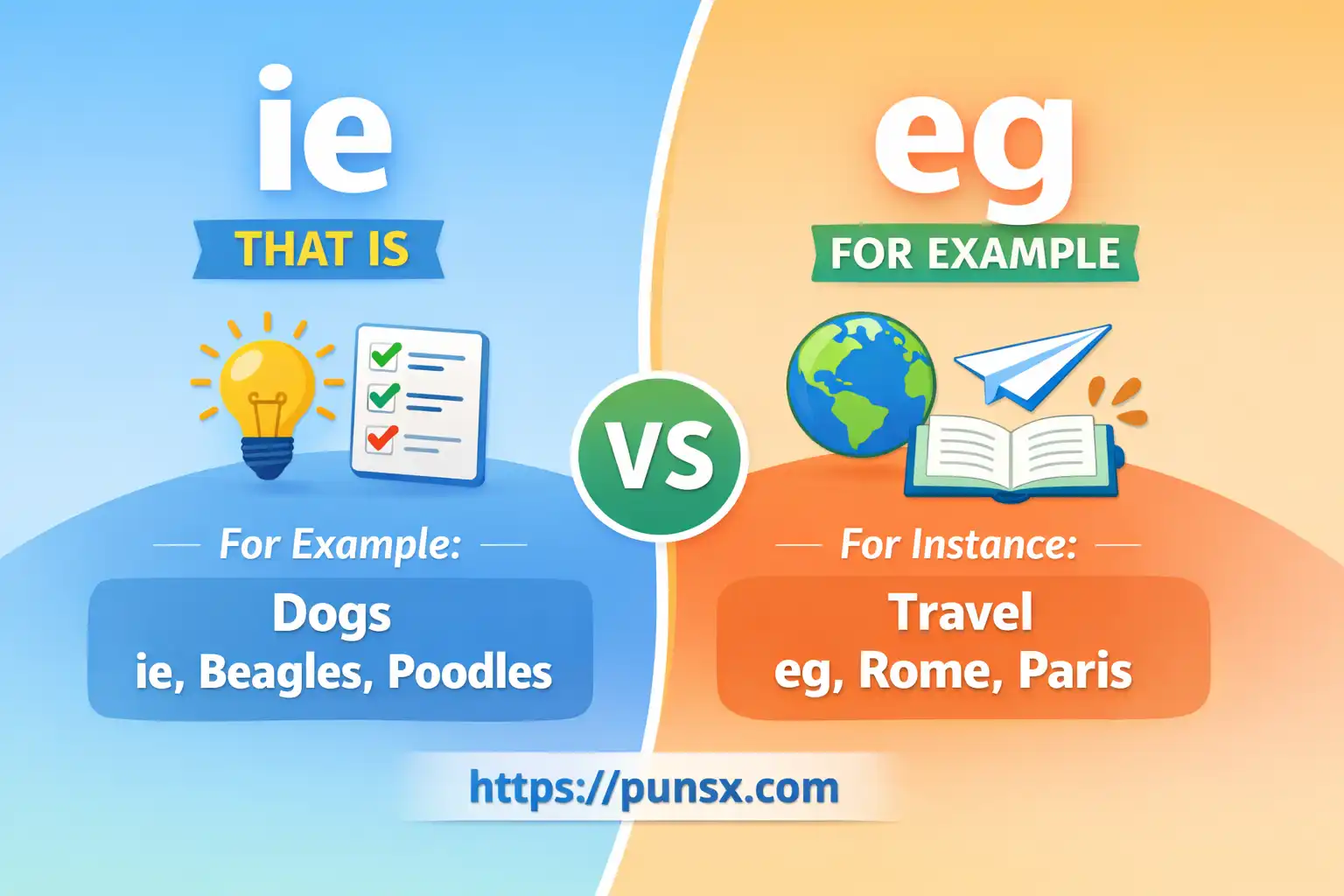
- ie means “that is” or “in other words”
- eg means “for example”
Easy rule:
If you can say “that means”, use ie.
If you can say “for example”, use eg.
Examples:
- I live in one city, ie, Paris.
- I like fruit, eg, apples and bananas.
The Origin of IE or EG
Both ie and eg come from Latin. Long ago, scholars wrote in Latin, so shortcuts were common. These shortcuts stayed, even after English changed.
- ie comes from id est. It means “that is.”
- eg comes from exempli gratia. It means “for the sake of example.”
Now, here is the problem. Most modern writers do not know Latin. So they see two short forms that look alike and sit in the same place in a sentence. Because of that, confusion grows.
Also, both often appear inside commas or brackets. That makes them feel interchangeable. But they are not. One narrows meaning. The other opens options. That difference matters.
British English vs American English Spelling
There is no spelling difference between British and American English for ie or eg. They are written the same everywhere.
However, punctuation style can change.
| Style | Example |
| British | eg apples, oranges |
| American | e.g., apples, oranges |
British writing often skips periods. American writing usually keeps them. In contrast, the meaning never changes. So focus on usage, not dots.
Which Spelling Should You Use?
Since spelling stays the same, the real choice is how formal your writing is.
- US writing: e.g., and i.e., with periods
- UK / Commonwealth: eg and ie without periods
- Global or professional writing: either is fine, but be consistent
Now, here is a simple tip. If your audience includes learners or the public, writing “that is” or “for example” can be clearer. Shortcuts save space, but words save confusion.
Common Mistakes with IE or EG
Writers often mix these up. Editors see the same errors again and again.
❌ I like cold countries, ie Canada and Norway.
✅ I like cold countries, eg Canada and Norway.
(These are examples, not the full meaning.)
❌ She speaks two languages, eg French.
✅ She speaks two languages, ie French.
(French explains which two.)
❌ Bring office supplies, ie pens and paper.
✅ Bring office supplies, eg pens and paper.
The key mistake is this: using ie when you really mean eg. That error changes meaning, not just style.
IE or EG in Everyday Examples
You see these shortcuts everywhere. Let’s look at real life.
Emails
- Please arrive early, ie, before 9 a.m.
- Bring snacks, eg, fruit or biscuits.
News
- The law affects small firms, ie, companies with under 10 staff.
Social media
- Weekend plans, eg, movies and pizza 🍕
Formal writing
- The test focuses on one skill, ie, reading comprehension.
In each case, ie defines. eg suggests.
IE or EG – Usage Patterns & Search Interest
Students, ESL learners, and early-career writers search [ie or eg] most often. They usually meet these terms in books or exams, then panic.
Search interest stays steady because the confusion never fully disappears. Grammar tools help sometimes, but they miss context. A sentence can look correct and still mean the wrong thing.
Imagine a work email saying:
“We will meet in one place, eg the main office.”
Now readers wonder: is the main office just one option, or the only place? That tiny choice affects plans. So yes, misuse causes real confusion.
IE vs EG Comparison Table
| Feature | ie | eg |
| Meaning | That is | For example |
| Part of speech | Abbreviation | Abbreviation |
| Context of use | Clarifies exact meaning | Gives examples |
| Formal or informal | Formal | Formal |
| Common mistake | Used for examples | Used for definitions |
| Correct example | One color, ie blue | Colors, eg blue and red |
This table shows the full story at a glance.
IE or EG FAQs
Is ie the same as eg?
No. ie explains. eg gives examples.
Which one is correct in formal writing?
Both are correct when used properly.
Can they be used interchangeably?
No, because they change meaning.
Why do people confuse them?
They look similar and come from Latin.
Can grammar tools catch this mistake?
Sometimes, but not always.
Is there a British vs American difference?
Only in punctuation, not meaning.
Conclusion
Overall, ie and eg look small, but they carry weight. One tells the reader exactly what you mean. The other shows some options. Mixing them up can confuse readers, slow understanding, or change plans.
In short, remember their job. ie closes the door and points to one thing. eg opens the door and shows a few things inside. That simple image helps many writers decide fast.
Finally, here is the one rule to keep forever:
If you can replace it with “that is,” choose ie.
If you can replace it with “for example,” choose eg.
Once you use that rule, this problem disappears. Writing feels easier. Reading feels clearer. And those two tiny letters stop causing big trouble.

I’m Donna Ashworth, author at PunsX.com, and I’m an expert in writing clever, fun puns.
I turn everyday ideas into light, shareable humor people enjoy.