People often stop mid-sentence when they reach farther or further. The words look close, they sound close, and spellcheck rarely helps. So the doubt stays. Many writers guess. Some switch words again and again. That small pause can break confidence, even in simple writing.
This confusion happens because both words talk about distance. But they do not always mean the same thing. In emails, school work, or news writing, a wrong choice can feel odd to the reader. It may not be “wrong” in a loud way, but it still feels off. That is why people keep searching this question.
In this guide, you will learn the clear difference. You will see when each word fits best. You will also see real examples from daily life. By the end, you will have one easy rule you can use every time, without stress.
Farther or Further – Quick Answer
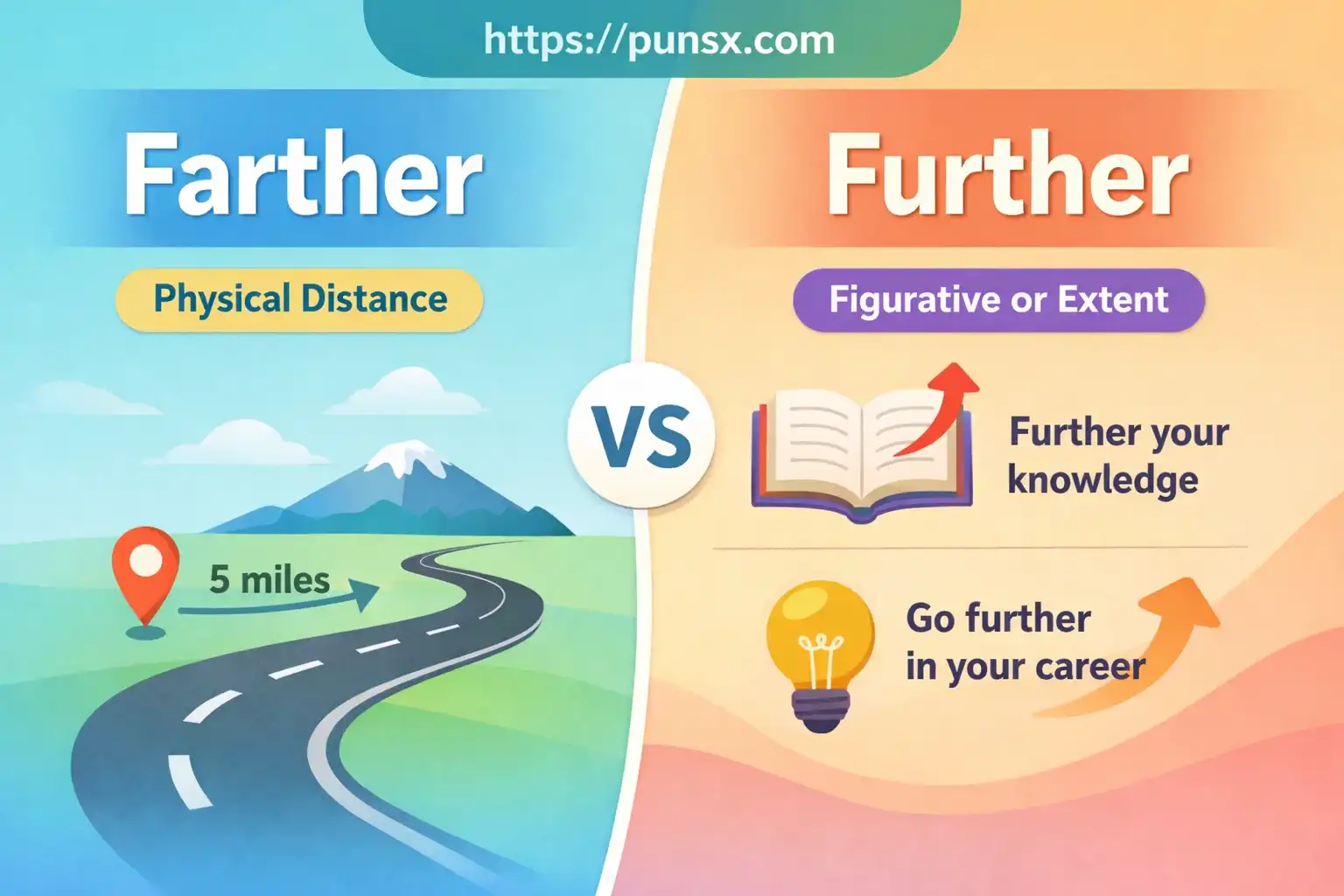
Farther is for real, physical distance.
Further is for ideas, time, or degree.
- “She walked farther down the road.”
- “We need to talk further about the plan.”
Easy rule:
If you can measure it, use farther. If you cannot, use further.
The Origin of Farther or Further
Both words come from the idea of being “far away.” Long ago, English used them in loose ways. Over time, writers tried to make meaning clearer. So the language slowly split the jobs.
Farther stayed close to space and distance. It talks about miles, steps, or places you can see.
Further grew wider. It began to mean more, extra, or deeper in thought.
Today, the confusion remains because both words still overlap in casual speech. People hear them used in similar places, so the line feels blurry. Still, in careful writing, the split helps readers understand faster.
British English vs American English Spelling
There is no spelling difference between British and American English here. Both use:
- farther
- further
However, usage style can change.
In American English, teachers often push a clear rule:
- Farther = physical distance
- Further = abstract distance
In British English, further is more common in many cases, even for distance. In contrast, farther still appears but less often.
| Region | Common Preference |
| United States | Clear split in meaning |
| United Kingdom | “Further” used more broadly |
Which Spelling Should You Use?
Since spelling does not change, the choice depends on audience and clarity.
For US readers:
Use the clear rule. Physical space gets farther. Everything else gets further.
For UK or Commonwealth readers:
You may see further used in more places. Still, farther is never wrong for real distance.
For global or professional writing:
Follow the meaning rule. It feels clean, clear, and safe for all readers.
Common Mistakes with Farther or Further
Writers often mix these words because they rush or rely on habit.
❌ We need to walk further to the store.
✅ We need to walk farther to the store.
(You can measure the walk.)
❌ I cannot help you farther with this issue.
✅ I cannot help you further with this issue.
(This is about degree, not space.)
❌ She ran further than anyone.
✅ She ran farther than anyone.
(This is a real distance.)
The mistake matters because it breaks flow. Readers may pause, even if they do not know why.
Farther or Further in Everyday Examples
Emails
- “Please read further instructions below.”
- “The office is farther than it looks.”
News
- “The storm moved farther north.”
- “The report will be reviewed further.”
Social media
- “No need to go further into drama.”
- “We drove farther than planned today.”
Formal writing
- “This study needs further review.”
- “The lab is farther from the city center.”
Farther or Further – Usage Patterns & Search Interest
Students, ESL learners, and writers search this topic most. Many want one simple rule they can trust. Editors also see this mistake often, even in strong writing.
The confusion usually shows up when someone edits a sentence twice. They switch words but feel unsure both times. In one real case, a report used farther discussion instead of further discussion, which made the sentence feel strange and unclear.
So the problem is not grammar fear. It is meaning clarity. This guide solves that by tying each word to one job.
Comparison Table: Farther vs Further
| Feature | Farther | Further |
| Meaning | Physical distance | Abstract distance |
| Part of speech | Adjective, adverb | Adjective, adverb |
| Context of use | Space, miles, steps | Time, ideas, degree |
| Formal vs informal | Neutral | Neutral |
| Common mistake | Used for ideas | Used for distance |
| Correct example | “He ran farther.” | “Let’s discuss further.” |
Semantic FAQs
Is farther the same as further?
No. They overlap, but their main uses differ.
Which one is correct in formal writing?
Both are correct when used with the right meaning.
Can they be used interchangeably?
Sometimes in casual speech, but not in careful writing.
Why do people confuse them?
They sound alike and share a common history.
Can grammar tools catch this mistake?
Sometimes, but meaning errors often slip through.
Is there a British vs American difference?
Yes, British English uses further more often.
Conclusion
Overall, farther or further is not a hard choice once the meaning is clear. The trouble comes from habit, not from complexity. When writers rush, they forget to ask one simple question.
If the sentence talks about real space, like roads or distance, farther fits best. If it talks about ideas, time, or degree, further is the right word. That small pause to check meaning saves confusion later.
In short, the one mistake to avoid is guessing. Guessing makes writing feel unsure. Instead, link each word to its job. Measure it or not. Space or idea.
Finally, remember this rule: If you can count it, use farther. If you cannot, use further. That rule works every time.