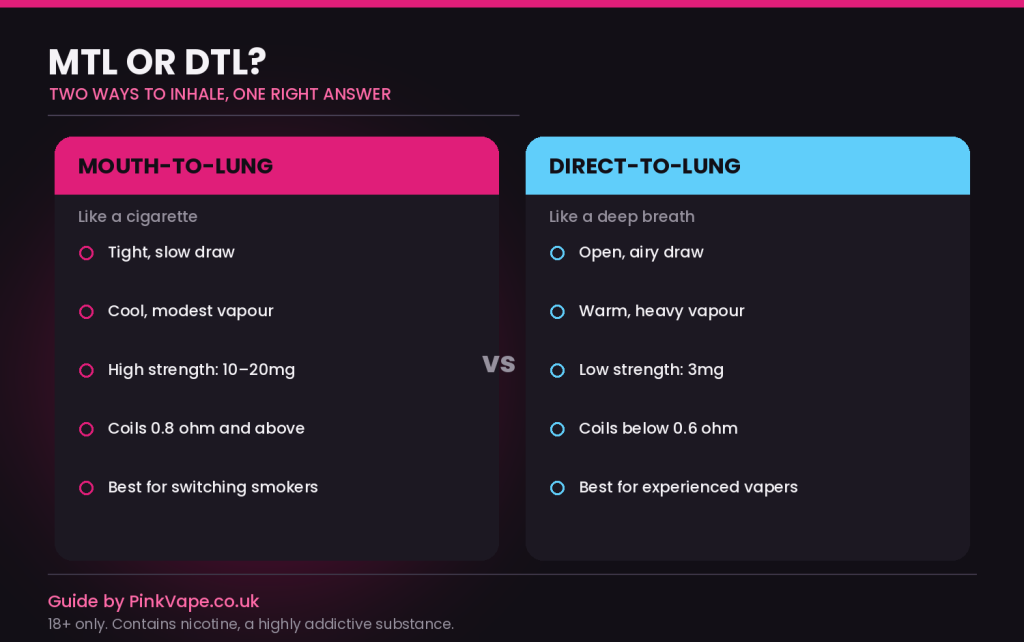
There are two completely different ways to inhale, they suit different people, and buying the wrong one is the commonest reason somebody decides vaping is not for them.
Somebody switching from cigarettes walks into a shop or opens a website and is asked about flavour, strength and price. What they are almost never asked is how they intend to inhale — despite that being the single decision most likely to determine whether the device feels right in their hand or faintly wrong for as long as they own it.
The vocabulary does not help. Mouth-to-lung and direct-to-lung sound like jargon invented to exclude people, and get abbreviated to MTL and DTL before anyone has explained what they mean. In fact the distinction is simple, physical, and easy to test on yourself in about ten seconds.
Here is what each one is, who each suits, and how the choice ripples into everything else you buy.
Two ways to inhale, and everything else follows from which you pick.
Test Yourself in Ten Seconds
Before any theory, do this. Imagine drawing on a cigarette. You pull smoke into your mouth, hold it a moment, then inhale it. That two-stage action is mouth-to-lung.
Now imagine taking a deep breath through a wide straw, straight down into your lungs in one motion. That is direct-to-lung.
If you have smoked, your body already knows the first one. That familiarity is not a small thing — it is most of why switching works at all, and it is why nearly every device aimed at former smokers is built around it.
Mouth-to-Lung in Detail
The airway inside the device is narrow, so drawing takes effort and the air moves slowly. Less air passing the coil means cooler vapour and less of it.
- The draw is tight and takes a second or two, exactly like a cigarette.
- Vapour is cool and modest in volume — discreet in public.
- It suits high nicotine strengths, typically 10mg or 20mg, because you take in relatively little vapour per puff.
- It uses higher-resistance coils, usually 0.8 ohm and above, which draw less power and last longer.
- Battery life is good, because the device is working gently.
This is the correct starting point for anyone leaving cigarettes, and for a great many people it remains the right answer permanently. There is no progression implied — plenty of experienced vapers have used nothing else for years.
Direct-to-Lung in Detail
The airway is much wider. Air moves freely, more of it passes the coil, and the device runs at considerably higher power to keep up.
- The draw is open and effortless, more like breathing than sucking.
- Vapour is warm and voluminous — conspicuous, and not discreet.
- It requires low nicotine strengths, typically 3mg, because each puff carries far more vapour.
- It uses low-resistance coils, below 0.6 ohm, which consume power and liquid quickly.
- Battery life is markedly shorter and you will refill more often.
This suits people who enjoy vaping as an activity rather than purely as a nicotine substitute, and it produces noticeably richer flavour when set up properly. It is a poor first purchase for a smoker, because the low nicotine strength it demands will leave the craving unresolved.
The Connection People Miss
Draw style, coil resistance and nicotine strength are not three separate decisions. They are one decision expressed three ways, and getting them out of step is what produces genuinely unpleasant experiences.
| Draw | Coil | Nicotine | What happens if you mismatch |
|---|---|---|---|
| MTL | 0.8 ohm and up | 10–20mg salt | 3mg here never satisfies; you vape constantly |
| DTL | Below 0.6 ohm | 3mg freebase | 20mg here delivers an enormous dose per puff |
That second row is worth dwelling on. Putting a 20mg nicotine salt into a powerful direct-lung device is the single most unpleasant mistake available in vaping — it produces immediate nausea and light-headedness, and it is a common way for people to conclude the whole category is not for them.
The rule in one line: the more air a device moves, the lower the nicotine strength must be.
How to Tell Which a Device Is
Most listings say so explicitly, and the ones that do not can be identified by their coil range. Anything supplied with coils of 0.8 ohm or higher is built for mouth-to-lung; anything supplied below 0.6 ohm is built for direct-lung. A Pink Vape product page or any well-run UK listing will state both the draw style and the coil resistance, which between them tell you everything.
- Prefilled pod kits and sealed devices are almost always MTL.
- Small refillable pod kits are usually MTL, sometimes with a restricted direct-lung option.
- Box mods with tanks are usually DTL, though many can do either.
- Devices with an airflow slider can often cover both, which is the most flexible option if you are undecided.
If You Want to Try the Other One
Moving from MTL to DTL is a common progression after six months or a year, usually motivated by wanting more flavour or more vapour. It is worth doing carefully.
- Change one variable at a time. Buy the lower-resistance coil first and keep everything else identical for a few days.
- Drop the nicotine strength before you open the airflow, not after.
- Switch to a thicker high-VG liquid, since thin liquid floods low-resistance coils.
- Expect the battery to last considerably less time and plan accordingly.
Moving the other way — DTL back to MTL — is easier and needs only a higher-resistance coil and a higher nicotine strength.
Restricted Direct-Lung: The Middle Ground
There is a third position that sits between the two, and it is where a great many experienced vapers end up.
Restricted direct-lung — usually abbreviated RDL — uses an airway wider than MTL but narrower than full DTL. You inhale straight to the lungs, but with noticeable resistance rather than freely. Coils are typically around 0.6 ohm, and nicotine strengths sit in the middle at roughly 6mg, or 10mg salt for some setups.
It offers most of the flavour and vapour benefit of direct-lung without the extreme liquid consumption, the very short battery life or the conspicuousness. If you have been vaping mouth-to-lung for a year and want more from it, this is usually a better next step than jumping to full sub-ohm.
Devices with an adjustable airflow slider will typically cover MTL through to RDL on a single coil, which makes them a sensible purchase for anyone who is genuinely unsure where they will settle.
What Each One Costs to Run
Draw style has a direct and often overlooked effect on what vaping costs you, because it determines how quickly you consume liquid.
| MTL | RDL | DTL | |
|---|---|---|---|
| Liquid per day | Low | Moderate | High |
| Coil life | Longest | Moderate | Shortest |
| Battery life | A day or more | Around a day | Under a day |
| Refills per day | About one | Two or three | Four or more |
The gap is substantial. Somebody vaping mouth-to-lung on a 2ml pod might refill once a day; the same person on a low-resistance direct-lung setup could be refilling four or five times and charging twice. Neither is wrong, but the running cost differs by a factor that surprises people who moved across without thinking about it.
This is also why direct-lung suits home use better than a day out. Carrying a bottle everywhere and hunting for a charger is a fair trade for the flavour if you are sitting at home; it is a genuine inconvenience on a train.
Frequently Asked Questions
Which should a smoker start with?
Mouth-to-lung, without hesitation. It replicates the action you already know and supports the nicotine strength you need.
Is DTL better?
No, only different. It produces more vapour and often richer flavour, at the cost of discretion, battery life and liquid consumption.
Can one device do both?
Some can, via an airflow slider and a coil change. That is the most flexible option if you genuinely do not know which you prefer.
Why did a DTL device make me feel unwell?
Almost certainly a nicotine strength intended for MTL. Drop to 3mg for any low-resistance setup.
Does MTL produce worse flavour?
Different rather than worse. MTL concentrates flavour in less vapour; DTL spreads it through more.
How do I know what I have?
Check the coil resistance printed on the pod. Above 0.8 ohm is MTL territory; below 0.6 ohm is DTL. Listings on pinkvape.co.uk and other UK specialists state this on every product.
Choosing Your First Device on This Basis
If you are buying now and want the decision made simply, here is the shape of it.
- Coming off cigarettes this month: a prefilled or simple refillable MTL pod kit, nicotine salt at the strength matching your habit.
- Been vaping MTL for a while and want more flavour: a refillable kit with adjustable airflow and a 0.6 ohm coil option, dropping to a lower strength at the same time.
- Interested in vaping as a hobby rather than purely a substitute: a device with a coil platform spanning several resistances, so you can move without buying again.
- Wanting something discreet for work or travel: MTL, every time. Direct-lung devices are conspicuous by design.
The one purchase to avoid is a powerful direct-lung device bought as a first vape by somebody leaving cigarettes. It is a genuinely good product being sold to precisely the wrong person, and it accounts for a disproportionate share of people who try vaping once and never return.
Common Misconceptions
A few things get repeated often enough to be worth correcting. Direct-lung is not an upgrade from mouth-to-lung; they are parallel options for different preferences, and plenty of long-term vapers never leave MTL. More vapour does not mean more nicotine — the strengths are deliberately lower to compensate, and total intake is broadly comparable. Nor does a bigger device automatically mean better flavour; a well-matched MTL setup often out-performs a badly configured sub-ohm one. If you are comparing options, listings at pinkvape.co.uk state draw style and coil resistance on each product, which makes the comparison concrete rather than guesswork.
One further misconception worth naming: that the choice is permanent. It is not. Coils are inexpensive, and on many devices moving between draw styles is a two-minute change rather than a new purchase. Try one, live with it for a fortnight, and change if it does not suit.
The Short Version
If you smoked, buy mouth-to-lung, use a nicotine salt at a strength that matches your habit, and ignore direct-lung entirely for the first few months.
If you later want more vapour, change the coil, then the liquid, then the strength — in that order, one at a time. Doing all three at once is how people end up feeling ill and blaming the device.
Age restriction and health notice
This article is intended for adult smokers and vapers aged 18 or over. Vaping products contain nicotine, which is a highly addictive substance. They are not suitable for non-smokers, under-18s, or anyone who is pregnant or breastfeeding. If you are trying to stop smoking, your local NHS Stop Smoking Service offers free support.