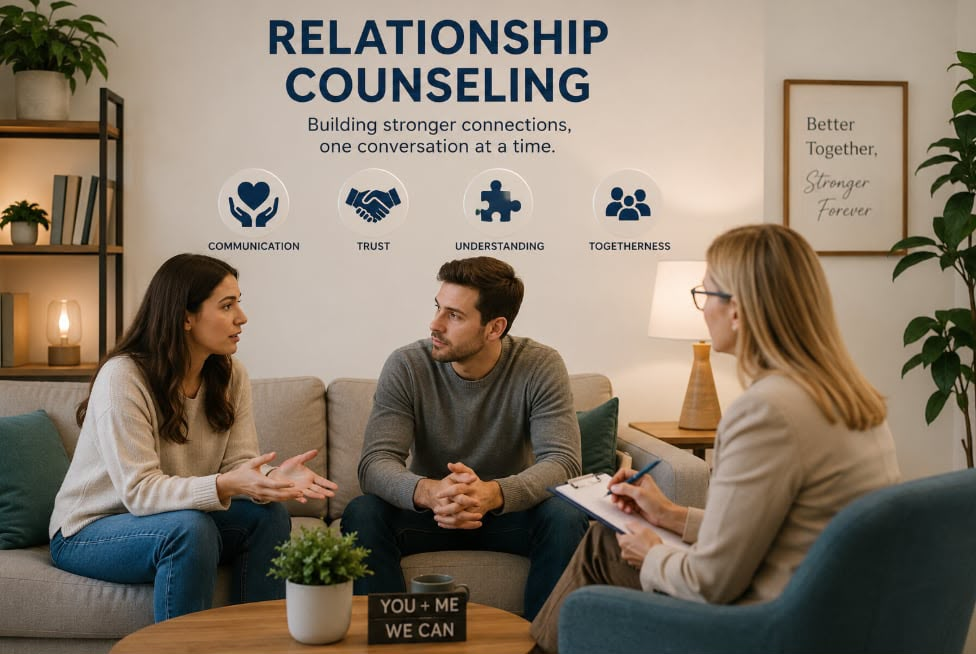
There’s a persistent myth that counseling is something you turn to only once a relationship is already in crisis — the last stop before separation, the thing you try when nothing else has worked. In reality, some of the most effective work happens well before that point, when two people notice a pattern repeating and decide to address it before it hardens into something harder to shift.
That’s the real function of relationship counseling: a structured, guided space where partners learn to see their own patterns clearly, communicate in ways that don’t escalate, and rebuild the kind of trust that day-to-day life quietly wears down. It’s not reserved for married couples in crisis, and it’s not a sign that something is fundamentally broken. Plenty of couples use it the way people use a regular checkup — not because something is wrong, but because maintenance matters.
What It’s Actually For
Relationship counseling covers a wider range of situations than most people assume. Some couples come in after a specific rupture — an affair, a major betrayal of trust, a fight that revealed something neither partner expected. Others come in because of slower, quieter erosion: growing apart after having kids, resentment that’s built up over years of uneven division of labor, or two people who love each other but have simply stopped knowing how to talk about hard things without one of them shutting down.
Premarital counseling falls under this umbrella too, often focused on surfacing expectations around finances, family, and conflict styles before they become flashpoints later. Some counselors specialize in specific populations — blended families, LGBTQ+ couples, interfaith or intercultural relationships, or partners navigating a major life transition like a health diagnosis or a cross-country move. The through-line across all of these is the same: a trained third party helping two people communicate more clearly than they can manage alone in the heat of the moment.
What a Session Typically Looks Like
Most relationship counseling follows a loosely consistent shape, regardless of the specific approach a counselor uses. An initial session or two usually focuses on intake — understanding each partner’s history, the relationship’s timeline, and what brought them in. From there, sessions typically involve some combination of structured conversation, guided exercises, and direct feedback from the counselor about patterns they’re noticing.
A skilled counselor doesn’t take sides, even when it might feel like it to one partner. Instead, they act more like a translator, helping each person understand what the other is actually trying to communicate underneath the words that come out during conflict. Much of the real work happens in those moments — slowing down an argument enough for both people to notice what’s actually driving it, rather than getting stuck on the surface-level disagreement.
Different counselors draw on different frameworks. Some use structured models like the Gottman Method, which focuses heavily on specific communication patterns and conflict “repair” techniques. Others lean on emotionally focused therapy, which centers on identifying the underlying attachment fears driving conflict. Neither approach is inherently better — fit between the counselor’s style and the couple’s needs matters more than which brand-name method is being used.
Why People Wait Too Long to Try It
Despite how normal relationship counseling has become, plenty of people still hesitate. Some worry that seeking counseling means admitting the relationship is failing. Others assume a counselor will simply tell them who’s “right.” A fair number of people simply don’t know how to bring it up with a partner without the conversation itself turning into a fight.
The reality tends to be less dramatic than the fear. Most counselors will say that couples who come in earlier, before resentment has calcified into contempt, tend to make faster progress than those who wait until things feel unsalvageable. That doesn’t mean counseling can’t help later-stage conflict — it often can — but earlier intervention generally means less ground to repair before real progress starts.
There’s also a quieter benefit that rarely gets mentioned upfront: simply having a neutral space to talk, guided by someone trained to keep both people accountable, often reveals things about a relationship that neither partner had fully articulated on their own, even to themselves.
Making the Most of the Process
A few things tend to separate couples who get real value out of counseling from those who don’t:
- Both partners actually want to be there. Counseling works best as a mutual choice, not something one partner drags the other into. If one person is only attending under pressure, that’s usually worth naming directly in the first session.
- Homework matters. Most counselors assign exercises or conversations to practice between sessions. The couples who do this consistently tend to see faster progress than those who treat the weekly session as the only place the work happens.
- Discomfort is often a sign of progress, not failure. Sessions that surface a difficult truth or an uncomfortable pattern are frequently the ones that matter most, even though they don’t feel good in the moment.
- Fit with the counselor matters as much as credentials. It’s reasonable to try a session or two and switch if the approach or personality doesn’t feel like the right match — that’s a normal part of finding the right fit, not a sign counseling itself doesn’t work for you.
Every couple’s timeline looks different, and it’s common to need a few sessions before real trust in the process builds. To find out more details, please visit ReachLink.
A Different Way to Think About It
Relationship counseling isn’t an admission of failure, and it isn’t reserved for couples standing at the edge of a breakup. At its best, it’s simply a space where two people who care about each other get help doing something that’s genuinely hard to do alone — seeing their own patterns clearly enough to change them. For couples willing to show up and do the work, that alone can be enough to shift a relationship’s entire trajectory.